


ULTRAPIPE – ultrasonic testing system for large-diameter pipes
Equipment features
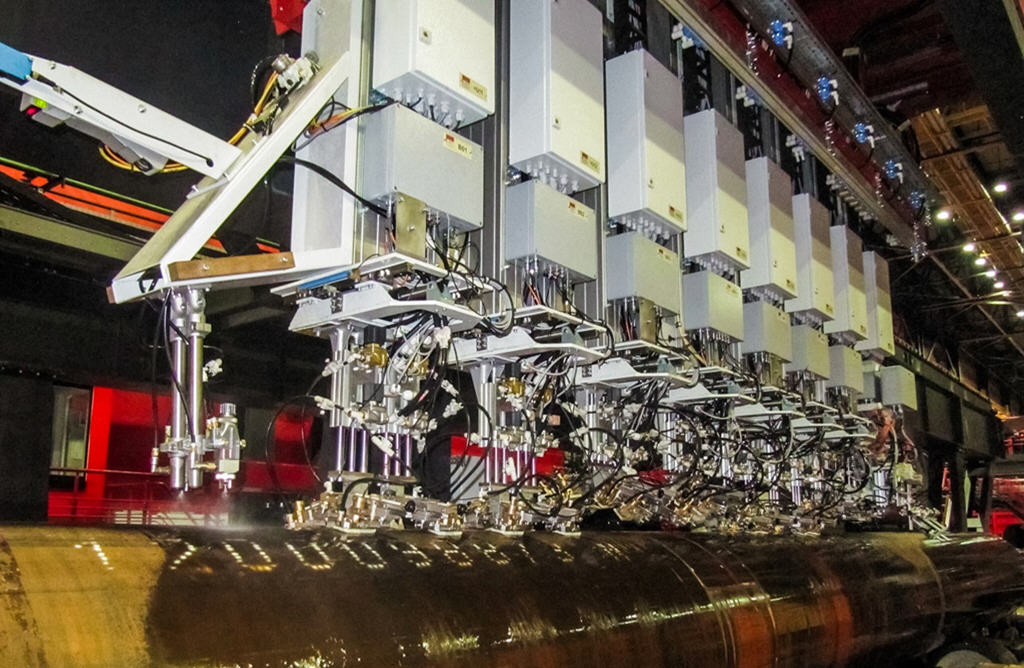
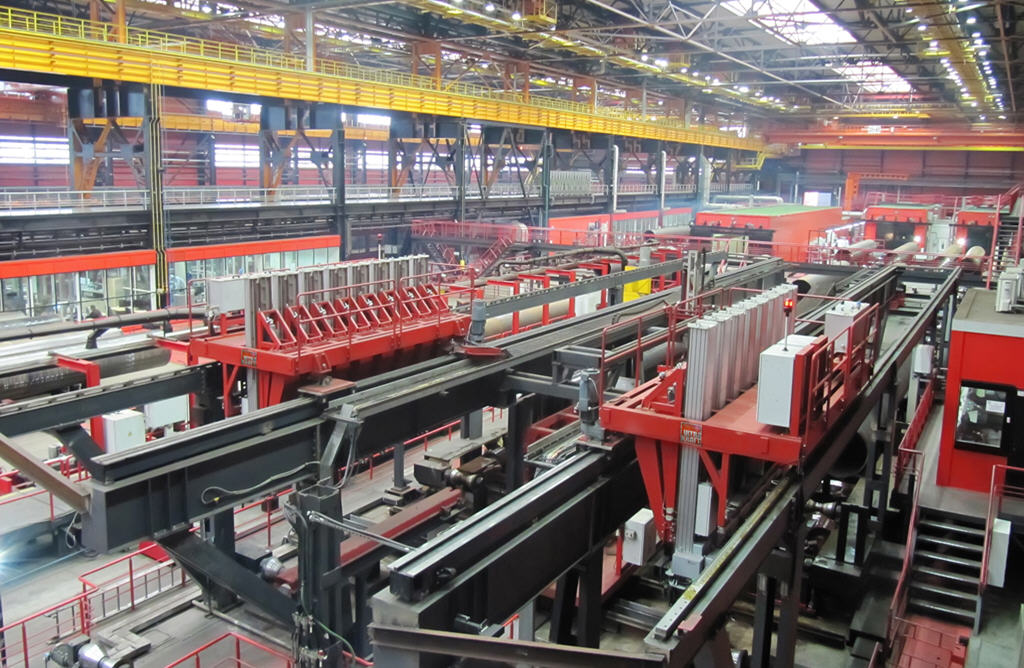
The system design includes mechanical equipment that moves the large-diameter pipes through the testing zone; pneumatic and hydraulic systems that position the acoustic transducer units; automation equipment, electronic instrumentation and a control computer system.
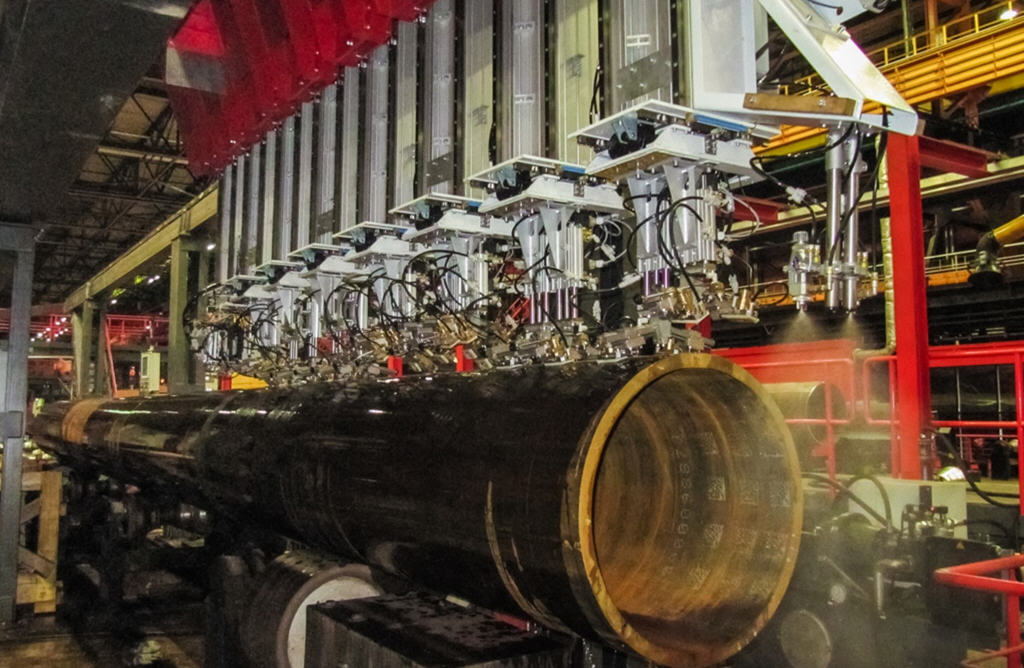 ULTRAPIPE systems implement a group of methods for continuous ultrasonic testing of large-diameter electric-welded pipes made of low-carbon and low-alloy steels. The operating principle is based on ultrasonic flaw detection methods involving the transmission, reflection and mode conversion of ultrasonic vibrations in metals.
The pipe is scanned continuously using piezoelectric transducers (conventional probes, phased arrays) or electromagnetic acoustic transducers (EMATs); ultrasonic testing can be performed both with conventional piezoelectric transducers and with phased arrays.
The phased array scans the weld cross-section at various angles in real time. This makes it possible to detect unfavourably oriented critical defects in the weld.
All testing units are mounted on a movable module (platform) that moves them along the rotating pipe while it is being scanned.
The automatic system allows in-line calibration of the equipment, with automatic loading and unloading of the reference standard.
Functional composition of the system:
- Weld testing system;
- Base metal testing system;
- Pipe end testing system for laminations and radial defects over a scanning zone width of up to 300 mm;
- Additional insonification schemes required by special specifications, namely: testing for transverse defects in the near-weld zone, On-bead, TOFD.
For each defective pipe, an inspection report with a defect location map (defectogram) is printed. Defective pipe sections are marked with paint.
Control computer system
All systems are connected to a single control computer system, which coordinates their operation, manages information flows, and ensures the testing process as well as the collection, processing, presentation and storage of results.
The control computer system organises:
- testing in accordance with the established rejection rules;
- real-time diagnostics;
- pipe sorting;
- display of information on defective zones and tracking of their images on the mimic diagram;
- classification of discontinuities as "acceptable" and "unacceptable";
- alarms for unacceptable defects and output of a control signal to activate the defect marker;
- printing of inspection reports, archiving and storage;
- communication with the higher-level computer (integrated system).
Quality testing system for welded joints and the heat-affected zone
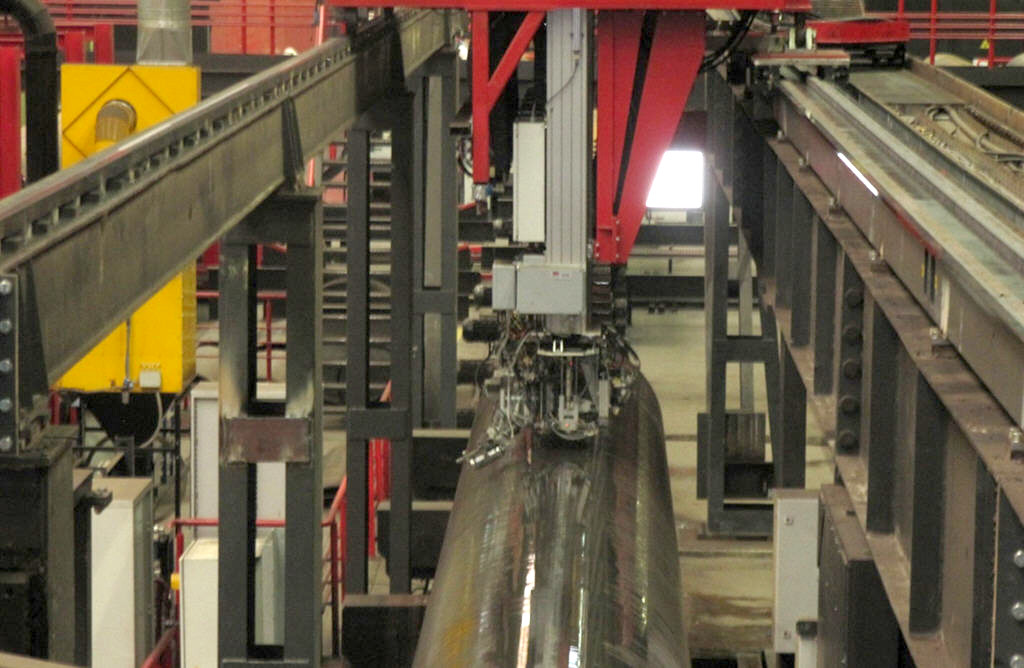
Sensitivity adjustment and functional checks of the system are performed using reference reflectors in the form of drilled holes of a specified diameter or notches in accordance with API 5L.
Base metal and pipe end testing system
The pipe ends are tested in a continuous band by a module mounted on the outer surface of the pipe.
Flaw detection electronics
The flaw detection electronics are housed in compact units with IP67 protection rating (in accordance with the international standard IEC 60529, as well as DIN 40050 and GOST 4254-96) and are fully electromagnetically compatible with the customer's equipment.
Each flaw detection electronics unit can contain up to 32 direct (non-multiplexed) channels.
The new flaw detection electronics consume 8 times less power than similar equipment from other manufacturers and therefore heat up less, so there is no need for liquid cooling, which is expensive and unreliable in plant conditions.
Equipment calibration
The equipment allows regular automatic calibration using a reference standard (calibration block).
Two types of calibration are available:
- using a small-size reference standard with artificial defects, with automatic loading/unloading of the reference standard;
- using a full-size pipe with artificial defects in the process line.
Quality assessment
The system provides sensitivity to defects equivalent to a 3 mm diameter flat-bottom hole (pipe end testing system, base metal testing system), as well as to defects whose reflectivity is equivalent to a milled notch 0.2 mm deep and 50 mm long made along and across the weld axis on the inner and outer surfaces of the pipe (weld and near-weld zone testing system).
Quality assessment is performed in accordance with the requirements of API 5L, GOST 31447, GOST 14782, ISO 3183, DNV-OS-F101, Shell Technical Specifications, Specification INTECSEA, as well as the special requirements of PAO Transneft and PAO Gazprom (including the specifications of the Shtokman and Nord Stream projects).
Specifications of the test objects (large-diameter pipes)
| Parameter | Value |
| Types of pipes tested | Large-diameter submerged arc welded (SAW) pipes |
| Pipe surface condition | As hot-rolled |
| Pipe diameter | 508 – 1420 mm |
| Pipe length | up to 18.5 m |
| Straightness deviation | up to 3 mm/m |
| Pipe wall thickness | 6 – 50 mm (over 50 mm – optional) |
| Spiral weld testing speed | from 3 to 25 m/min |
| Throughput | up to 28 pipes/hour |
Videos of the equipment in operation